
Some golf balls fly like they’ve signed a secret contract with gravity. Others seem to ignore physics completely. That strange gap is exactly why this golf ball comparison using real launch monitor results matters more than most golfers think.
Robot-tested golf balls reveal measurable differences in distance, spin, launch angle, ball speed, and consistency. Independent launch monitor results consistently show that premium urethane golf balls outperform cheaper ionomer models in greenside spin and overall control, while some mid-priced balls deliver nearly identical driver distance for less money.
Why Do Robot-Tested Golf Balls Matter?
Robot testing matters because it removes human inconsistency and shows the true performance differences between golf balls.
Most golfers judge performance based on feel or a single good round. A golf robot does not have good days or bad swings. It repeats the same swing speed, attack angle, and club delivery every time. That creates reliable data for golf ball comparison testing.
Companies and independent reviewers often use systems like TrackMan, Foresight GCQuad, and robotic swing machines to measure:
- Ball speed
- Carry distance
- Total distance
- Spin rate
- Launch angle
- Peak height
- Dispersion
- Stopping power
These launch monitor results help separate marketing claims from actual performance.
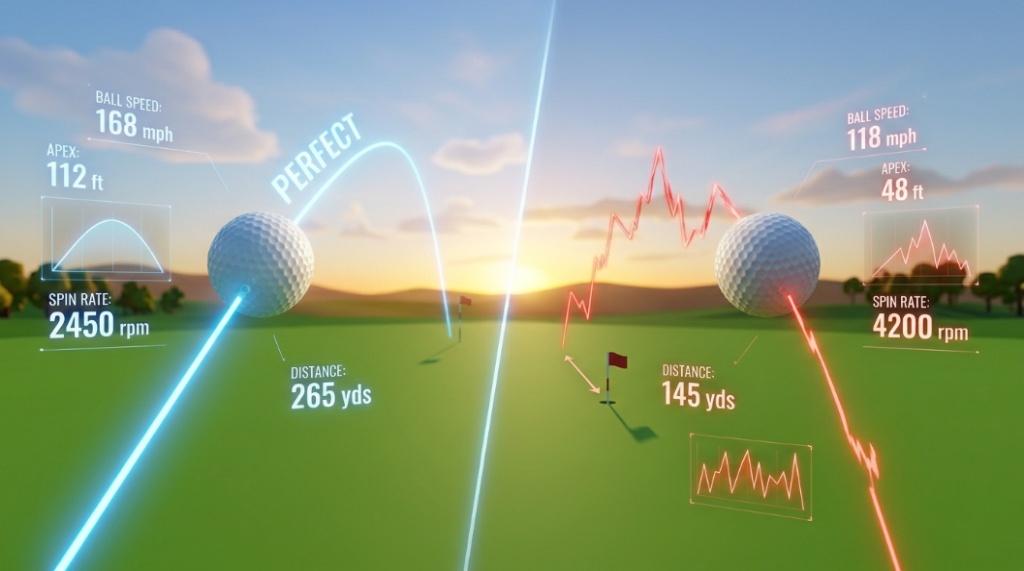
For example, robot testing regularly shows that two balls advertised as “tour quality” can produce completely different spin numbers around the green. A difference of even 500 RPM with wedges can change stopping distance dramatically.
Which Golf Ball Actually Performs Best Overall?
The best overall robot-tested golf ball is typically the Titleist Pro V1 because it balances distance, spin, feel, consistency, and short-game control better than most competitors.
That said, “best” depends heavily on player type and swing speed.
Independent golf ball comparison studies from publications like MyGolfSpy, Golf Digest, and launch monitor testing channels consistently place several models near the top:
| Golf Ball | Best For | Strength | Potential Weakness |
|---|---|---|---|
| Titleist Pro V1 | All-around performance | Consistency and control | Higher price |
| Titleist Pro V1x | Higher launch players | More spin and height | Can over-spin for fast swingers |
| TaylorMade TP5 | Soft feel seekers | Short-game spin | Slightly less durable |
| Callaway Chrome Tour | Balanced performance | Ball speed | Premium cost |
| Srixon Z-Star XV | High swing speeds | Distance and stability | Firmer feel |
| Bridgestone Tour B X | Fast swingers | Low driver spin | Less soft around greens |
No single ball dominates every category. Some balls launch higher. Others spin less with the driver but more with wedges.
What Do Launch Monitor Results Actually Measure?
Launch monitor results track how a golf ball behaves immediately after impact and throughout flight.
Many golfers focus only on total distance, but launch monitor data reveals far more useful information.
What Is Ball Speed?
Ball speed measures how fast the ball leaves the clubface. Higher ball speed usually means more distance.
Premium golf balls often produce slightly faster ball speeds because of better core technology and energy transfer.
Robot testing regularly shows premium balls gaining 1–3 mph over budget balls. That can translate into several extra yards.
Why Does Spin Rate Matter?
Spin rate affects both control and distance.
Too much driver spin reduces rollout. Too little wedge spin makes it harder to stop shots on the green.
Tour players often optimize:
- Driver spin: 2,000–2,700 RPM
- 7-iron spin: 6,000–7,500 RPM
- Wedge spin: 8,000–11,000 RPM
Launch monitor results consistently show urethane-covered balls producing significantly higher wedge spin than surlyn-covered distance balls.
Why Is Launch Angle Important?
Launch angle influences trajectory and carry distance.
A ball launching too low may lose carry. Too high can create ballooning shots in wind.
Robot testing helps identify balls that optimize launch conditions for different swing speeds.
Do Expensive Golf Balls Really Go Farther?
Premium golf balls usually go slightly farther, but the biggest advantage is consistency and short-game control.
Distance differences in robot testing are often smaller than golfers expect.
Many launch monitor comparisons show:
- Premium balls gain only 3–7 yards with driver
- Mid-priced balls can nearly match carry distance
- Short-game spin differences are much larger
For example, a two-piece distance ball might perform almost identically off the tee compared to a premium tour ball. But inside 100 yards, the premium ball often creates noticeably more stopping power.
That difference matters more for scoring.
Which Golf Ball Performs Best for Average Golfers?
Mid-compression golf balls often perform best for average golfers because they combine forgiveness, moderate spin, and affordable pricing.
Golfers with swing speeds between 85–100 mph usually benefit from balls that reduce excessive side spin while maintaining decent greenside feel.
Popular options include:
- Callaway Supersoft
- Srixon Q-Star Tour
- TaylorMade Tour Response
- Bridgestone e12 Contact
- Vice Pro
Robot testing frequently shows that average golfers lose very little driver distance using these models compared to premium tour balls.
The larger difference often comes from feel preference and short-game spin.
What Is the Difference Between Urethane and Ionomer Golf Balls?
Urethane golf balls provide more spin and control, while ionomer balls focus more on durability and distance.
This is one of the most important distinctions in any golf ball comparison.
| Feature | Urethane Cover | Ionomer Cover |
|---|---|---|
| Greenside Spin | High | Lower |
| Feel | Softer | Firmer |
| Durability | Moderate | High |
| Price | Premium | Budget-friendly |
| Used by Tour Players | Yes | Rarely |
Launch monitor results repeatedly show that urethane balls create more spin with wedges and short irons.
That added control explains why nearly every PGA Tour player uses urethane-covered golf balls.
Which Golf Ball Has the Lowest Driver Spin?
Low-spin golf balls help reduce slices and maximize distance for many golfers.
Robot testing often identifies these as low driver-spin performers:
- Bridgestone Tour B X
- Titleist AVX
- Callaway Chrome Tour X
- TaylorMade TP5x
- Srixon Z-Star XV
Lower driver spin can increase rollout and reduce side-spin curvature.
However, golfers should avoid choosing the absolute lowest-spin ball without testing. Too little spin can reduce carry distance and hurt stopping power on approach shots.
Which Golf Ball Spins the Most Around the Greens?
Tour-level urethane golf balls produce the highest greenside spin in robot testing.
Models consistently ranking near the top include:
- Titleist Pro V1
- TaylorMade TP5
- Srixon Z-Star
- Callaway Chrome Soft X
- Mizuno Pro X
High greenside spin helps:
- Stop chips faster
- Create more check on pitches
- Improve control on firm greens
- Increase precision with wedges
Launch monitor wedge testing often reveals 1,000–2,000 RPM differences between premium and budget balls.
How Much Does Compression Affect Performance?
Compression affects feel and launch characteristics, but modern golf ball fitting matters more than chasing a specific compression number.
Low-compression balls generally:
- Feel softer
- Launch higher
- Reduce vibration
High-compression balls generally:
- Suit faster swing speeds
- Provide stability
- Offer lower driver spin
Robot launch monitor results show compression influences performance less than many marketing campaigns suggest.
Core construction, mantle layers, and aerodynamics often play a bigger role.
Can Amateur Golfers Actually Notice Golf Ball Differences?
Most amateur golfers can notice differences in feel, wedge spin, and trajectory even if driver distance changes are small.
Many players assume all golf balls perform similarly. Robot testing proves otherwise.
Real-world examples include:
- Higher wedge spin causing shorter rollout
- Lower driver spin reducing slice curvature
- Softer covers improving putting feel
- Different trajectories in windy conditions
Golfers often notice these differences more during scoring shots than tee shots.
Are Direct-to-Consumer Golf Balls Worth It?
Several direct-to-consumer golf balls perform surprisingly well in robot testing while costing significantly less than major brands.
Popular DTC golf ball brands include:
- Vice
- Snell
- Kirkland Signature
- Seed
- Piper
Launch monitor results frequently show these balls competing closely with premium models in ball speed and spin.
For example, the Kirkland Signature golf ball gained attention because robot testing revealed extremely high wedge spin at a fraction of premium-ball pricing.
Some trade-offs may include:
- Less durability
- Inconsistent quality control
- Slightly different feel
Still, many golfers can save substantial money without losing meaningful performance.
How Do Weather Conditions Affect Golf Ball Testing?
Weather dramatically affects golf ball performance, which is why indoor robot testing provides cleaner comparisons.
Wind, humidity, altitude, and temperature all influence:
- Carry distance
- Spin behavior
- Trajectory
- Ball speed
Cold temperatures especially reduce compression efficiency.
Many golfers lose noticeable distance in winter because colder golf balls become firmer and less responsive.
Indoor launch monitor results help isolate the golf ball itself instead of environmental variables.
Should You Choose a Golf Ball Based on Swing Speed?
Swing speed matters, but overall launch conditions and scoring performance matter more.
Golf ball fitting has evolved significantly.
Instead of simply matching “soft ball for slow swing” or “firm ball for fast swing,” modern fitters evaluate:
- Launch angle
- Spin profile
- Peak height
- Shot dispersion
- Short-game control
Many average-speed golfers now use premium balls successfully because they value greenside spin more than raw driver distance.
What Is the Best Golf Ball for Distance?
Low-spin multi-layer golf balls generally produce the best total distance in robot testing.
Common top performers include:
- Titleist Pro V1x Left Dash
- TaylorMade TP5x
- Bridgestone Tour B X
- Callaway Chrome Tour X
- Srixon Z-Star XV
These balls often combine:
- Fast ball speed
- Efficient aerodynamics
- Lower driver spin
- High energy transfer
However, chasing maximum distance alone can hurt scoring performance if wedge control suffers.
What Should Golfers Learn From Robot Testing?
Robot testing shows that golf ball selection genuinely matters, especially for consistency and short-game performance.
The biggest takeaway is not that one golf ball dominates every category. Instead, launch monitor results prove that the “best” ball depends on your priorities.
If you want:
- Maximum greenside spin → choose premium urethane
- Lower driver spin → choose firmer tour models
- Budget performance → explore DTC options
- Soft feel → use lower-compression designs
- Consistency → stick to one model long term
The smartest golfers test golf balls the same way they test drivers or irons.
Conclusion: Which Robot-Tested Golf Ball Wins?
The best robot-tested golf ball is the one that improves your scoring, not just your launch monitor distance numbers.
Launch monitor results consistently show that premium balls like the Titleist Pro V1, TaylorMade TP5, and Callaway Chrome Tour offer elite all-around performance. But mid-priced and direct-to-consumer options have narrowed the gap more than many golfers realize.
The biggest performance differences usually appear around the greens, not off the tee. That means golfers should focus less on marketing claims and more on measurable results like spin consistency, trajectory, feel, and dispersion.
If you have never tested golf balls side by side, you are probably leaving strokes on the course without realizing it.
Take a few models to a launch monitor session. Compare your wedge spin, driver launch, and carry numbers. The data may completely change the ball you trust on the first tee.
The right golf ball is not hype. It is equipment fitting.
FAQ: Robot Tested Golf Ball Questions
Which golf ball performed best in robot testing?
The Titleist Pro V1 consistently ranks among the best in robot testing because of its balanced distance, spin, feel, and consistency across all clubs.
Do expensive golf balls really make a difference?
Yes. Premium golf balls usually provide better greenside spin, more consistent launch conditions, and softer feel, although driver distance gains are often small.
What launch monitor numbers matter most for golf balls?
The most important launch monitor results include ball speed, spin rate, launch angle, carry distance, and shot dispersion.
Are soft golf balls better for slower swing speeds?
Soft golf balls can help some slower swingers improve feel and launch, but overall fitting matters more than compression alone.
Which golf ball spins the least with the driver?
Golf balls like the Bridgestone Tour B X, Titleist AVX, and TP5x often produce very low driver spin in robot testing.
Can average golfers benefit from premium golf balls?
Yes. Many average golfers gain more control and stopping power around the greens with premium urethane golf balls.
What is the best budget golf ball according to launch monitor results?
Vice Pro, Srixon Q-Star Tour, and Kirkland Signature frequently perform well in golf ball comparison testing while costing less than major premium brands.
📌 Related Reads
Discover: Robot Tested Golf Balls: Which One Actually Performs Best?