
Golf has a reputation for being an expensive sport. Between club sets, green fees, and apparel, the costs add up fast. However, improving your game does not require a massive budget. Some of the most effective training tools and accessories cost very little, and many golfers overlook them entirely.
The right low-cost golf gear can sharpen your swing, clean up your short game, and help you track progress over time. You do not need to spend hundreds of dollars to see real improvement on the course. You just need to know what actually works and where to find it.
This guide covers the best affordable golf tools available today, what each one does, and why it deserves a spot in your bag or practice routine.
Why Affordable Golf Tools Deserve More Respect
There is a common assumption in golf that expensive means better. Premium clubs and high-end gadgets dominate the marketing landscape. However, the fundamentals of improvement have not changed. Repetition, feedback, and consistency are what build a better golfer. Many inexpensive tools deliver all three without the premium price tag.
Additionally, beginner and intermediate golfers often benefit more from basic training aids than from expensive technology. A simple alignment stick, for example, teaches proper setup in a way that no rangefinder can replicate. Therefore, starting with affordable tools is not just a budget decision. It is often the smarter one.
Alignment Sticks
Alignment sticks are one of the most widely recommended tools by golf coaches around the world. They are simple fiberglass rods, usually sold in pairs, and they cost very little. Yet their impact on your game can be enormous.
You use them to check your stance, clubface direction, ball position, and swing path. Place one rod on the ground pointing toward your target and another across your feet. Instantly, you can see whether your body is aimed correctly at address.
Many golfers spend years fighting a slice or pull without realizing that poor alignment is the root cause. A single practice session with alignment sticks can reveal problems that would otherwise take months to diagnose. Additionally, professional tour players use them in every practice session, which says everything about their value regardless of price.
You can typically find a pair for under ten dollars. That makes them arguably the best return on investment in all of golf.
A Quality Putting Mat
Putting accounts for roughly 40 percent of your total strokes in a typical round. Yet most amateur golfers spend the majority of their practice time hitting full shots. Shifting some focus to putting delivers faster score improvement, and a home putting mat makes that easy.
A good putting mat does not need to be expensive. Mid-range options in the twenty to forty dollar range provide a consistent, realistic surface for practicing stroke mechanics, distance control, and alignment. Many include cup inserts and alignment guides that help you identify stroke flaws quickly.
The biggest advantage of a putting mat is convenience. You can practice in your living room for fifteen minutes before work each morning. That kind of regular, low-pressure repetition builds a more consistent stroke far faster than occasional trips to the practice green.
Swing Path Trainer or Impact Bag
Understanding your swing path is essential for ball striking improvement. A swing path trainer helps you feel the correct arc of your club through the impact zone. Most are simple curved guides or rails that cost between fifteen and thirty dollars.
An impact bag is another excellent option. It is a cushioned target that you swing into at full speed. The feedback you get from striking the bag teaches you where your clubface is pointing and how your hands are positioned at impact. This kind of feel-based feedback is extremely valuable for building muscle memory.
However, the key is using these tools consistently. A swing path trainer used twice a week for a month will do far more for your game than an expensive lesson without follow-up practice. Therefore, pairing a cheap training aid with regular commitment is a powerful combination.
A Divot Repair Tool and Ball Marker Set
These are small items, but they belong in every golfer’s bag. A divot repair tool fixes pitch marks on the green, which is both a courtesy to other players and a rule of the game. Ball markers are used to mark your ball’s position on the green before lifting it.
Both items are available together for just a few dollars. Many sets come with a magnetic clip that attaches to your hat or glove for quick access. This type of discount golf accessory is easy to overlook, but showing up without one is poor etiquette and can slow down play.
Choosing a divot tool with a comfortable grip and a sturdy build ensures it lasts for years. Spending a little more than the absolute minimum here is worth it, as a flimsy tool can damage greens rather than repair them properly.
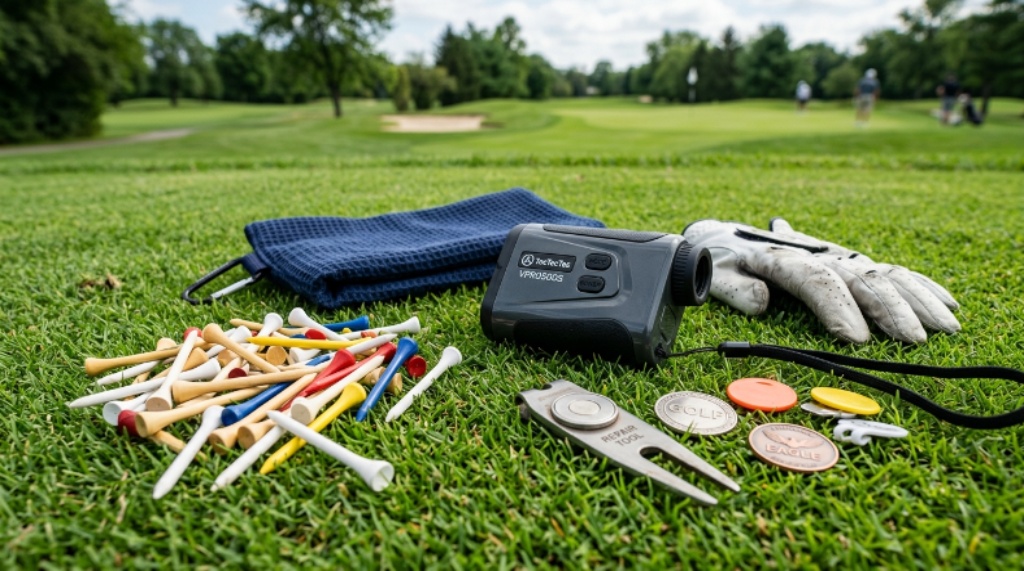
A Tee Holder and Variety Tee Pack
Tees are small, but the right tee height makes a measurable difference in driver performance. Using a tee that is too low reduces launch angle and limits distance. A tee that is too high promotes thin contact and inconsistent strikes.
Buying a mixed pack of tees in various heights lets you experiment and find what works best for your driver and fairway woods. A pack of one hundred tees costs almost nothing, and a simple tee holder keeps them organized in your bag.
Additionally, brush tees and zero-friction tees are increasingly popular. They reduce resistance at impact and can add a few yards to your drives. These are available for a modest premium over standard tees and are still firmly within the category of golf essentials that any player can afford.
A Rangefinder or GPS Golf App
Knowing your exact distance to the pin changes how you make club selection decisions. Many golfers guess, and guessing leads to unnecessary mistakes. A rangefinder takes the guesswork out of approach shots entirely.
Entry-level laser rangefinders have dropped significantly in price over the past few years. Reliable models are now available for between forty and seventy dollars. For recreational golfers, these provide all the accuracy needed for better course management.
If even that price is beyond your current budget, free and low-cost GPS golf apps are a strong alternative. Many smartphones can run apps that provide accurate distances to the front, center, and back of each green on thousands of courses worldwide. The technology has improved dramatically, and the accuracy is more than sufficient for most amateur rounds.
However, a dedicated rangefinder is faster and easier to use mid-round than a phone app. Therefore, if you play regularly, it is worth saving up for even an entry-level model.
A Grip Training Aid or Rubber Grip Trainer
Your grip is the only point of contact between your body and the club. Yet most golfers never receive any formal instruction on how to hold a club correctly. A grip trainer is a simple rubber attachment that slides onto your existing club grip and positions your hands in the correct position automatically.
These cost between five and fifteen dollars and are remarkably effective for beginners and high-handicap players. They teach proper hand placement through repetition without requiring constant conscious attention. After enough practice with a grip trainer, the correct feel becomes natural and transfers to your regular clubs.
Additionally, grip trainers are useful for players who have developed bad habits over time. Resetting a grip is difficult when muscle memory fights against change. A trainer removes the guesswork and forces your hands into the right position every time you pick up the club.
A Scorecard Holder and Pencil Clip
Tracking your scores accurately is one of the simplest ways to measure improvement. A scorecard holder with an attached pencil clip keeps your scorecard dry, flat, and easy to write on. These small items cost just a few dollars and prevent the frustration of a soggy or crumpled scorecard on a wet day.
Keeping detailed records of your rounds, including fairways hit, greens in regulation, and putts per hole, gives you data to work with. Over time, patterns emerge that show you exactly where your game is losing strokes. This kind of self-analysis is one of the most underrated forms of improvement available to amateur golfers.
Conclusion
Improving your golf game does not require spending a fortune. The tools covered in this article prove that. Alignment sticks sharpen your setup, a putting mat builds stroke consistency at home, and a swing path trainer teaches better mechanics through feel. Small items like divot tools, tees, and grip trainers address fundamentals that many players neglect entirely.
The best approach is to start with the areas of your game that cost you the most strokes. For most amateur golfers, that is putting and alignment. Invest in those tools first and build from there. Discount golf accessories and low-cost golf gear are not a compromise. They are a smart entry point into a better game. The golfer who practices consistently with simple tools will always outperform the one who owns expensive gear but never uses it.
Frequently Asked Questions
What are the most important golf tools for beginners?
Beginners benefit most from alignment sticks, a grip trainer, and a putting mat. These three tools address setup, hand position, and putting stroke, which are the foundations of a consistent game. All three are available at low cost and deliver fast, noticeable improvement.
Are cheap golf training aids as effective as expensive ones?
For most amateur golfers, yes. The fundamentals of alignment, grip, and putting mechanics do not require expensive technology to practice. Simple, well-designed tools often teach the same lessons as premium alternatives at a fraction of the cost.
How often should I use golf training aids at home?
Even fifteen to twenty minutes of deliberate practice three to four times per week produces meaningful improvement. Consistency matters more than duration. Short, focused sessions with a putting mat or alignment sticks are far more effective than occasional long practices.
Do rangefinders really help lower your score?
Yes. Accurate distance information leads to better club selection, which reduces the number of approach shots that miss the green. For golfers who currently guess yardages, switching to a rangefinder or GPS app typically results in immediate improvement in approach play.
Where is the best place to buy affordable golf accessories?
Online marketplaces like Amazon offer a wide range of budget options with customer reviews to guide your choice. Discount sports retailers and end-of-season sales at golf shops are also excellent sources. Additionally, second-hand golf stores and online resale platforms carry used training aids in good condition at very low prices.