
You’ve finally decided to take the plunge into fresh pasta making. The only thing standing between you and a countertop dusted with flour is the rather daunting price tag attached to those shiny KitchenAid attachments. Buying a stand mixer is a big investment, and adding the pasta roller and cutter set on top of it can feel like you’re paying for a second appliance. The good news? You don’t have to pay full retail price to get restaurant-quality results. With a little strategy, patience, and know-how, you can secure the best value KitchenAid pasta attachments without sacrificing quality. This guide breaks down every practical way to save money, from understanding what you truly need to identifying the best times to buy.
You’re likely here because you want fresh tagliatelle, fettuccine, or perfectly thin lasagna sheets without blowing your budget. The problem is that most buying advice focuses on which attachment to buy, not how to buy it for less. That’s where this guide differs. We’ll peel back the layers of retail pricing, talk about bundling strategies, and show you how to get premium performance for a fraction of the cost. Let’s get your pasta game on track without wrecking your wallet.
Why Are KitchenAid Pasta Attachments So Expensive?
The sticker shock is real. A full set—roller plus three cutters—can cost nearly as much as a budget-friendly stand mixer. The high price isn’t just about the brand name; it’s about engineering and materials that are built to last. Understanding this helps you know where you can save and where you shouldn’t skimp.
The Cost of Precision Engineering
These attachments aren’t plastic toys. They feature solid metal gears and precision-machined rollers. The cutting blades are sharp enough to last for decades if cared for. This is a case where ‘you get what you pay for’ applies, but it also means you should focus on seeking discounts for a quality product rather than buying a subpar knockoff.
Accessories vs. Made-In-Italy Quality
Many of these attachments are manufactured in Italy, where there’s a hundred-year tradition of pasta-making machinery. The stainless steel used is often military-grade, resisting corrosion from acidic dough. This durability is a main cost factor. If you see a generic, cheaper attachment online, check the metal grade—you may end up eating rust flecks in your pasta, which is a risk not worth taking.
To get a high-end product without the high-end retail price, you have to play the waiting game. Sign up for stock alerts for your preferred model on sites like Amazon or Sur La Table. Often, older models are discounted when a new version drops, even if the changes are purely cosmetic.
When Is the Best Time to Buy KitchenAid Pasta Attachments?
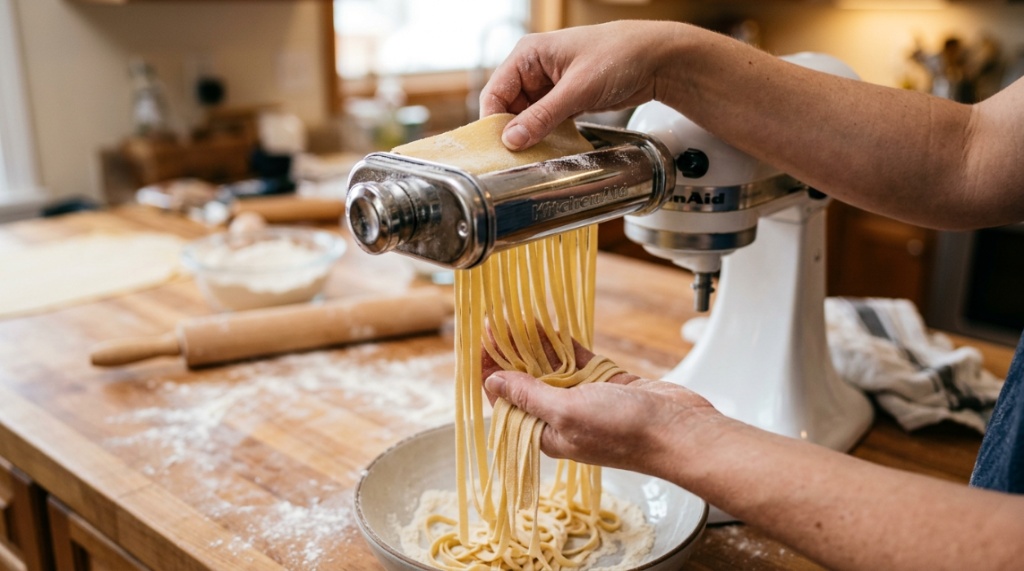
Timing is everything. If you walk into a store in November expecting a sale, you might be disappointed. KitchenAid attachments usually see their lowest prices during specific shopping windows. Knowing these windows can save you up to 30% off the list price,
Place this link in a section comparing alternative pasta makers or motor-driven options to give readers a high-end motorized alternative to KitchenAid attachments.
Major Sales Events You Can’t Miss
Prime Day in July is a prime (pun intended) opportunity. Historically, the full pasta attachment set drops to near-record lows. Similarly, Black Friday and Cyber Monday are solid bets, but keep an eye on inventory—these bundles sell out fast. Another key window is after the holidays in mid-January, when retailers clear out leftover stock to make room for new inventory.
Targeting Warehouse and Open-Box Deals
Don’t dismiss open-box items. If you buy from a reputable retailer like Williams Sonoma or directly from Amazon Warehouse, an open-box attachment is often either a customer return that was unopened or, at worst, has minor scuffs on the box. The gears are usually pristine. You can save 20-25% just for letting someone else store the box for a week. Always check the return policy, though—you want the ability to send it back if the metal is damaged.
Which KitchenAid Pasta Attachment Set Gives You the Most Bang for Your Buck?
You don’t necessarily need the massive 3-piece set. Knowing which set is the cheapest per function is key to maximizing value. The “3-piece set” (roller + fettuccine + spaghetti) is often the sweet spot, but sometimes buying them individually is cheaper than buying the boxed set—especially if you catch two separate sales.
Comparing the 3-Piece Set vs. Individual Purchases
Let’s break down the math. The full 3-piece set usually retails around $199.99. Buying them individually, the roller is typically $129.99, and each cutter is $79.99. That’s a total of $289.97. During a seasonal sale, the set often drops to $149.99. In this scenario, the set wins. However, during clearance events, you might find the roller heavily discounted to $80 and the cutters to $50 each, making the individual route cheaper. Use a price-tracker like CamelCamelCamel to monitor historical price lows before you pull the trigger.
Why You Should Skip the “5-Piece” Glitter Kit
There is a bigger set that includes a ravioli maker and a spaghetti press. Unless you are a professional caterer, skip it. The ravioli attachment is notoriously fiddly and you’ll get more use out of a simple rolling pin and stamp cutter. The best value KitchenAid pasta attachments are often found in the standard sets, not the gimmicky luxury boxes that double the price but halve the usability.
How to Spot a Counterfeit or Low-Quality Attachment
Online marketplaces are flooded with “compatible” attachments that look identical at first glance. They are often half the price of the real deal. The risk? They are made with zinc alloy that contains lead, and they strip out after three uses. Here is how to spot a scam before you waste money.
The Weight and Finish Test
Authentic KitchenAid attachments are heavy. If you are buying in person, pick up the box. The roller should feel solid and dense. A cheap knockoff feels hollow and has a shiny, painted appearance, while the genuine article has a brushed, matte steel finish. If buying online, look for the “Ships from and sold by Amazon.com” tag or the official KitchenAid vendor storefront.
Reading the Fine Print on Compatibility
Some third-party units claim to fit all models, but often fail to fit the newer ‘lift bowl’ models with different hubs. The genuine attachments include a specific hub connector that prevents wobbling. If you buy a generic one, you risk harming the motor of your mixer. Spending $30 to save money can easily cost you $500 in mixer repairs down the line—that’s the opposite of a bargain.
Can You Buy Used KitchenAid Pasta Attachments Safely?
The term “pre-owned” often sends shivers down the spines of home cooks, but for mechanical metal items, it’s actually a smart move. Unlike non-stick pans, metal rollers age gracefully. A used attachment that has been cleaned well will perform identically to a new one.
Where to Find High-Quality Used Attachments
Facebook Marketplace is your best friend here. Look for sellers in affluent neighborhoods who are moving or decluttering—they often price to sell quickly. Also, check estate sales. Many older folks bought these attachments but never used them; you can often snag them at 40% off retail. Garage sales on Sunday afternoons are also prime hunting grounds, as sellers are more willing to negotiate rather than pack everything back up.
What to Check Before You Buy a Used Unit
Ask the seller for a video of the roller turning. It should spin smoothly with no grinding. Check the inside of the hopper for signs of rust—a little flash rust can be cleaned, but pitting cannot. Finally, ask if they ever used it with squid ink dough. This black pigment can stain the metal and permanently taint your future dough. If they hesitate, walk away.
How to Use Bundling and Rebates to Lower the Cost
If you haven’t bought the mixer yet, you have a huge advantage. Buying a mixer and attachment combo can save you more than buying them separately. This is because retailers often use attachments as a “loss leader” to sell the higher-margin mixer.
Bundling with the Mixer Purchase
During promotional events, brands like Sur La Table or Bed Bath & Beyond often offer a “free attachment” ($149 value) with the purchase of a Professional Series mixer. If you need the mixer anyway, this effectively gives you the roller for free. You then only need to buy the cutters, which are frequently on sale for $69.99. This route gives you a full setup for half the MSRP.
Credit Card Points and Cash-Back Portals
This is a less obvious hack. If you pay with a credit card that offers 5% cash back at department stores, that’s a discount. Additionally, use a browser extension like Rakuten or Honey. During peak sales, these portals offer an additional 5-10% cash back on KitchenAid products. Stack this on top of a sale, and you’re looking at the lowest possible price without hacking the system.
How to Maintain Your Attachments to Avoid Re-Purchasing
The true cost of an attachment isn’t just the purchase price—it’s the cost per use. You can buy the best attachment in the world, but if you ruin it in six months, you’re back to square one. Proper care is your saving grace. This is the part of money-saving advice that most people skip.
The Cleaning Method That Saves Your Gears
Never, ever soak these in water. The metal will rust, the gears will clog, and the rollers will seize. The correct way to clean is to let the dough dry, brush it off with a stiff pastry brush, and wipe with a damp cloth. This preserves the bearings and prevents the need for repair or replacement.
Storage Solutions That Prevent Damage
The metal is durable, but the cutting edges are sensitive to knocks. Store the attachments in a drawer with a cloth between them, or better yet, in the original box. Dropping them on a counter can bend the tines of the fettuccine cutter, making them dull—leading you to think you need a new one when you just need to store it safely.
Is Buying a “Premium” Attachment Worth the Splurge?
KitchenAid occasionally releases a “Copper” or “Stainless Steel Collection” that costs significantly more than the standard set. The question is whether these improvements justify the higher price tag for the home cook.
Standard Steel vs. Premium Copper
Copper has superior heat conduction, which is great for pastry dough, but for pasta, it makes no difference whatsoever. The performance is identical to standard steel. The only reason to buy these is for aesthetics—if your mixer sits on a counter facing a dining room. If you are budget-conscious, the standard set offers the exact same extrusion and cutting quality at a 30% lower price.
Evaluating “Pro” Models for Home Use
The “Pro” line often features a wider roller. This is excellent if you make huge lasagna sheets, but for the average dinner, the standard 6-inch width is perfect. Paying $50 more for the pro version doesn’t improve the taste or texture of the pasta; it just means you use slightly more flour to roll out a wide strip.
What Are the Hidden Costs of Cheap Knockoffs?
We touched on this briefly, but let’s look at the true long-term expense of buying cheap. It’s a classic “false economy.” You might save $60 now, but the financial and culinary damage can be severe.
The Motor Strain Factor
Knockoff rollers often have tighter or looser tolerances. If the gap isn’t set correctly, the roller jams the motor. This forces your mixer to run hot, potentially stripping the plastic worm gear inside the mixer head. Replacing that gear costs $100 in parts plus labor if you aren’t handy. Suddenly, your $30 attachment became a $150 repair bill.
The Toxicity Risk
Generic metal attachments are rarely food-grade certified. They may contain cadmium or lead in the alloy and paint. When you push dough through, tiny particles of metal dust can flake off into your food. That’s not just a money problem—it’s a health hazard. Brands like KitchenAid adhere to strict FDA regulations. The peace of mind alone is worth spending the few extra dollars.
How to Negotiate the Price In-Store
Physical retail isn’t dead. If you have a local kitchen supply store, you have negotiating power that you don’t have online. Store managers often have the ability to drop prices 10-15% if it means making a sale, particularly for floor models or the last unit in stock.
Asking for the “Open Box” Discount at Checkout
Pick up the display box, bring it to the counter, and ask, “Is this the last one? The box looks a bit battered.” Most stores will automatically offer you a 10% discount. If they don’t, ask if they have a “damaged packaging” discount code. This works best on weekdays when sales associates have more time to process a manual markdown.
Using Price-Match Guarantees
Pull up a competitor’s price on your phone while standing in the store. If you find the same SKU for $20 less at Target or online at Best Buy, ask the store to match it. Many retailers will match, and some even offer an extra 10% of the difference if you ask politely. It’s awkward to do, but it’s a legit way to instantly save cash.
Are Bundles with the Ravioli Maker Ever a Good Value?
Let’s revisit the box sets. The “Gourmet” set includes the three basic tools plus a ravioli maker and a pasta cutter for angel hair. The retail price jumps significantly. To decide if this is a value, you need to assign a cost to your time and frustration.
The Usability Factor
The ravioli attachment is notoriously finicky. It requires you to center the dough perfectly, and it jams easily. Most users end up reverting to manual stamping. If you value your sanity, buying the $199.99 3-piece set and a $15 manual ravioli stamp is a better use of money than buying the $300 set and never using the extra parts.
Resale Value of Extra Parts
If you do buy the large set because it was discounted below the price of the standard set, you can simply resell the unwanted ravioli maker on eBay. This is a sneaky way to effectively lower the cost of the parts you want. If you move the ravioli maker for $60, your standard set ended up costing you around $100. That’s the ultimate hack.
How to Check for Warranty and Refurbished Options
KitchenAid sells factory-certified refurbished products directly on their website. These are attachments that were returned due to minor defects, fixed, tested, and sold with a warranty. They are usually 25% cheaper than new ones. This is a low-risk way to save serious money.
The Refurbished Policy Explained
Certified refurbished means they have replaced the gears and sharpened the blades. They are visually indistinguishable from new. You get a one-year warranty, which is shorter than the standard 5-year, but for the price savings, it’s a trade-off most are willing to make. Always ensure the “refurbished” label comes from KitchenAid, not a third-party repair shop.
Extending the Life After Purchase
Register your attachment on the KitchenAid website. Often, they email you a 10% off coupon for your next accessory purchase, just for signing up. Use that coupon to buy the next cutter you need, effectively reducing your overall spend over time.
Frequently Asked Questions
Can I use a generic brand attachment to save money safely?
While some generic attachments work, we recommend against it. The tolerances for the metal gears and rollers are often inaccurate, which can damage your mixer’s motor. Saving $50 now can lead to a $200 mixer repair later, so it’s not worth the risk to your appliance or your health.
How long should I wait for a sale on KitchenAid attachments?
If you are not in a rush, wait for Amazon Prime Day (July) or Black Friday (November). You can also see significant discounts during the “After Christmas” clearance in early January. On average, waiting 3-4 months can save you up to 30%.
Is the stainless steel set the best value?
Yes, the standard stainless steel set offers the best durability and performance for the price. The “Copper” or “Pro” versions offer no substantial functional benefit for the average home cook; they simply look more attractive and cost more.
Can I clean the attachments in the dishwasher?
No, never put them in the dishwasher. The extreme heat and strong detergents will strip the lubricant from the gears and cause steel to rust. Always clean with a dry brush and a damp cloth.
What is the difference between the two “cutter” discs included?
The discs refer to the cutting rollers for spaghetti (thin) and fettuccine (wide). You need both for versatility. If you only make one type of pasta, you can buy the roller and one cutter separately to save initial cost.
Do I need the attachment hub cover to save money?
Yes, keep the small silver hub cover that came with your mixer safe. If you plan to buy attachments used or individually, you’ll need this cover to prevent flour from getting into the mixer housing when the attachment is not in use.
Conclusion
Saving money on KitchenAid pasta attachments isn’t about waiting for a magical 90% off clearance—it’s about being strategic with your timing and knowing exactly what you need. The path to the best value involves a mix of patience, seasonal sale tracking, and careful consideration of used or refurbished items. You can absolutely own a professional-grade pasta setup without paying full retail. Remember, the core goal is to get fresh, delicious pasta on your table, and you can do that with a $150 set just as effectively as with a $400 one.
Don’t let the sticker price scare you away from the joy of rolling your own dough. Start monitoring those prices, check your local marketplace, and consider the refurbished route. Use the savings to buy high-quality flour and eggs—that’s what actually makes the difference in flavor. The machine just shapes it. Now, get out there and find that deal.