
Does your living room feel flat, uninspired, or just a little too “showroom sterile”? You walk into a store, see a beautifully styled sofa, and think, “There’s no way I can replicate that without spending a fortune.” The secret isn’t expensive designer cushions—it’s the technique. You don’t need a massive budget to transform your sectional into a magazine-worthy centerpiece. In fact, with a few clever tricks and a sharp eye for detail, you can achieve that high-end, layered look for less than the cost of a pizza delivery. This is the essence of budget couch pillow styling: using smart placement, texture contrast, and affordable finds to create a luxurious feel. Let’s break down exactly how to master this skill at home, without breaking the bank.
Why Does Pillow Styling Make or Break a Sofa’s Look?
Pillows are the jewelry of your living room. They add personality, warmth, and color, but when done haphazardly, they can make a couch look cluttered or chaotic. Styling isn’t just about fluffing; it’s about intentional design. When you understand the “why” behind the arrangement, you can achieve a pulled-together look that elevates the entire space, even on a tight budget.
The Visual Weight of Pillows in Room Design
Think of your couch as a canvas. Without pillows, it’s a solid block of fabric. Adding pillows breaks up that monotony, drawing the eye and creating visual interest. They also anchor the seating area, making the room feel more inviting and cohesive. On a budget, this is your cheapest tool for a dramatic room refresh.
How Pillows Reflect Your Personal Style
Your pillow choices are a direct reflection of your taste. Are you a minimalist who prefers clean lines and neutral tones? Or a maximalist who loves bold patterns and tassels? The beauty of affordable styling is that you can experiment with trends without the guilt of a high price tag. It’s the simplest way to change your room’s mood with the seasons.
Why Texture Beats Color (Sometimes)
When shopping on a budget, you might feel limited to solid colors. But texture is your secret weapon. A chunky knit, a smooth velvet, a rough linen—these create depth and luxury that solid colors alone cannot. Even a monochromatic palette can look rich and expensive if you mix textures properly.
What Is the Golden Ratio for Pillow Arrangement?
There’s a simple mathematical formula that designers use to make pillows look perfect: the 2:1 rule. For every two solid pillows, use one patterned one. This creates balance without overwhelming the eye. Start here, and you’ll instantly see a difference. It’s the quickest win for beginner stylists.
Standard Pillow Sizes: 18×18 vs. 20×20
Don’t waste money on odd sizes. Stick to the industry standards. An 18×18 inch insert is perfect for smaller loveseats, while 20×20 inch inserts are better for deep sofas. Mixing these two sizes creates a casual, layered look that feels professional. Mixing too many similar sizes looks flat and boring.
How to Mix Patterns Without Clashing
Afraid of mixing florals and stripes? Use the color wheel. If your pillows share at least one common color, they will harmonize. For example, a striped pillow with a navy stripe can pair perfectly with a floral pillow that has a tiny navy dot. This trick ensures cohesion, even with mismatched patterns.
When to Use Odd Numbers (And When Not To)
The old rule of “always use odd numbers” is a guideline, not a law. On a three-seater sofa, three large pillows look great. On a two-seater, two or four is better. The key is to balance the visual weight of the sofa. A bigger couch can handle more volume; a smaller one gets overwhelmed easily.
How to Choose a Color Palette That Looks Expensive
Color selection is where most people go wrong. The easiest way to look high-end on a budget is to mimic a monochromatic palette with pops of contrast. Pick one main color, one neutral, and one accent. This formula works for every style, from bohemian to modern.
The 60-30-10 Rule Applied to Pillows
This classic interior design rule works perfectly here. The 60% is your couch color (the base), the 30% is your main pillow color (the secondary), and the 10% is the accent pillow (the pop). Staying within this proportion keeps the eye relaxed and the space feeling intentional.
Neutral Bases with Bold Accents
If your couch is grey or beige, you have a blank canvas. Splurge on one bold, patterned accent pillow and keep the rest neutral. This is a huge money-saver because you only need one “wow” piece instead of five. The neutral pillows act as a buffer for the bold one.
Using Dark Hues for a Cozy Feel
Don’t be afraid of dark colors. A deep forest green or navy pillow can make a light-colored couch feel grounded and sophisticated. Dark pillows also hide stains better, which is a practical bonus if you have kids or pets. They add a sense of drama without being loud. Once your living space is beautifully set up for maximum coziness, ensuring your body gets the right ergonomic support is just as important—especially at night—so be sure to check out the Best Contour Knee Pillow for Side Sleepers in 2026.
Which Filler Material Gives the Best Shape?
The secret to that perfectly plump, “expensive” look isn’t the cover—it’s the insert! A cheap, flimsy insert will ruin even the most beautiful cover. You must invest in a high-quality, high-loft filler to achieve that structured, yet soft, look. It’s the difference between a pillow that stands up and one that slouches.
Down vs. Down-Alternative vs. Polyester
Down is luxurious but expensive and requires constant fluffing. Polyester is cheap but can look lumpy and flat over time. The sweet spot is a high-quality down-alternative (usually microfiber). It gives you the fluffy look of down without the high cost or maintenance.
The “Two-Sizes-Bigger” Insert Trick
Here’s a pro tip: buy an insert that is 2 inches larger than your cover. If your cover is 18×18, buy a 20×20 insert. This forces the cover to fill out completely, creating that perfectly plump, seamless appearance. It’s the cheapest way to make a cheap cover look custom.
How to Fluff Like a Professional
Don’t just punch the pillow. Grab it from the middle and knead it, then pull the edges outward. This redistributes the filling to the corners, giving it a fuller shape. This simple act can transform your couch in under a minute, making it look styled every day.
How to Layer Pillows Like a Designer (Step-by-Step)
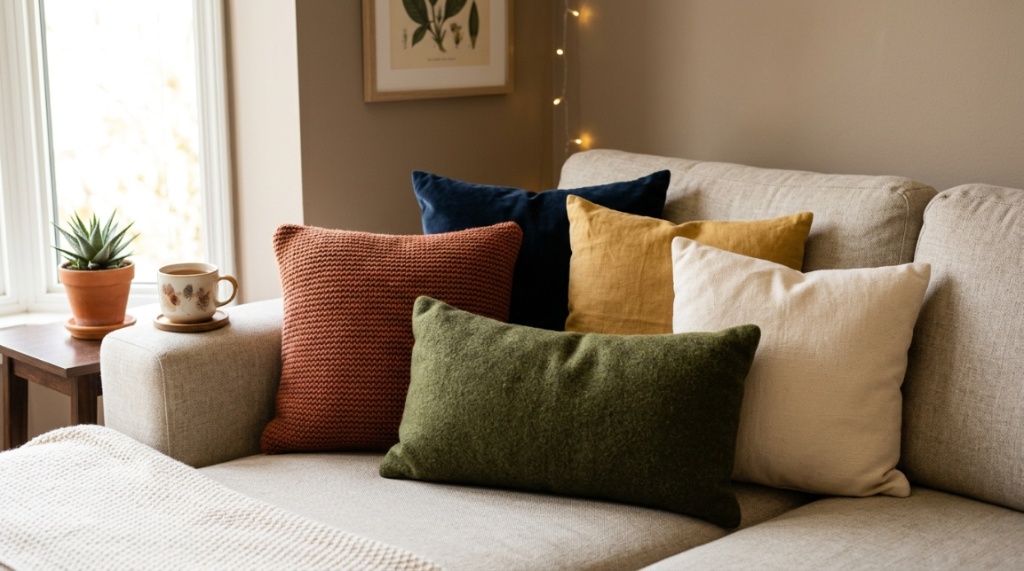
Layering is the magic that separates amateurs from pros. It’s about placing multiple pillows in a way that feels organic and inviting. Follow these simple steps to achieve the perfect look every time, using only what you already have at home.
Step 1: Start with the Largest Pillows at the Back
Place your largest pillows (usually 20×20 or 22×22) against the back of the sofa. These create the solid foundation for the arrangement. Angle them slightly inward toward the center of the sofa to create a welcoming V-shape. This is your base layer.
Step 2: Add the Medium Layer
In front of the large pillows, place your medium-sized ones (18×18 or 16×16). These can be leaning or upright. This layer adds depth and introduces your secondary color or pattern. Mixing these with your base layer creates visual interest and prevents the flat look.
Step 3: Finish with the Accent and Lumbar
Finally, place your smallest accent pillows or a lumbar pillow in the front. This is your “pop” layer. Use bold colors, ruffles, or unique textures here. The lumbar pillow works great as a focal point in the center, tying the whole arrangement together.
If you live in a warm climate and struggle with sourcing cheap decor, you might want to check out some local options for budget couch pillow styling to find specific deals that won’t break the bank.
Can You Mix Old Pillows with New Ones?
Absolutely! You don’t need to throw everything away. Mixing old and new is the core of budget styling. The trick is to update the covers while keeping the high-quality inserts you already have. This is the most economical way to refresh your space.
The Art of the “Second-Hand” Upgrade
Visit thrift stores or online marketplaces for unique vintage covers. You can often find high-end designer covers for pennies on the dollar. Wash them thoroughly, and you have a unique piece that adds character no store-bought pillow can replicate. This adds a story to your room.
Reusing Inserts vs. Buying New
If you have existing pillows with good loft, just buy new covers. There’s no need to buy new inserts unless they are flat and lumpy. A general rule: if the insert is older than 2 years and lost its shape, replace it. Otherwise, a new cover is all you need.
When to Retire a Pillow Cover
If a cover is stained, faded, or pilling, it’s time to go. Keeping worn-out covers on your couch makes the entire room look tired. Try to mix a seasonal update: buy two new covers for spring and two for fall, swapping them out to keep things fresh without a huge outlay.
Is There a “Cheap” Way to Fill Empty Space?
Yes, and it’s all about body pillows. If your sofa is wide, you have gaps between the back cushions. You can fill these with large, inexpensive body pillows. They add structure and height, acting like a base that other pillows lean against. It’s a designer secret that costs less than $15.
Using Bed Pillows as a Base
Don’t have body pillows? Use your old bed pillows! Place them vertically behind your decorative pillows. This creates a flat, solid support that prevents your decorative pillows from sinking into the cracks. It’s a zero-cost hack that instantly improves structure.
Solving the “Sink Hole” Problem
We all have that one saggy spot on the couch. Place a firm pillow directly in that area before adding your stylish ones. This not only supports your back but also provides a solid base for your arrangement. It makes your couch look brand new, not broken.
When Should You Change Your Pillow Covers?
To keep your space feeling fresh, you should rotate your pillow covers with the seasons or at least twice a year. This isn’t about buying new things; it’s about storing what you have and swapping. This strategy keeps your living room feeling new without a full remodel.
Seasonal Color Shifts (Spring/Summer vs. Fall/Winter)
In summer, opt for light linen, cotton, or seersucker in bright, airy colors. In winter, swap to velvet, wool, or chunky knits in warm, rich tones. This small change signals a seasonal shift in your home and makes the environment more comfortable for the weather.
Holiday and Event Styling
Who says you can’t have fun with pillows? For holidays, swap out just one or two accents (like a lumbar pillow) for a seasonal print. You don’t need to change the whole set. A few themed covers in a storage bin are all you need to celebrate festively.
How to Store Off-Season Pillows
Use vacuum-sealed bags to save space. Only include the inserts in the bags, not the covers. Store the covers folded neatly. This prevents dust and keeps them fresh. Label the bags clearly so you can quickly find the fall themes when the season changes.
Frequently Asked Questions
How many pillows should I put on my couch?
A standard three-seater sofa looks best with 3 to 5 pillows. A loveseat should have 2 to 4. The goal is to create a layered look without overcrowding the seating space. A good rule is to leave at least one seat totally clear of pillows for sitting.
Can I mix square pillows with round ones?
Yes, but use them sparingly. Round pillows (often called “bolsters” or “buddhas”) add nice variety, but they should be used as an accent piece in the front. Too many round shapes can look cluttered. One round pillow per couch is usually the sweet spot.
What size pillow is best for a deep sectional?
For deep sectionals (24-inch deep seats), choose 22×22 or even 24×24 inch pillows. Smaller pillows will get lost in the depth. If your sofa is too deep, fill the space behind your pillows with a body pillow to push them forward.
Is it cheaper to buy inserts or covers?
Buying just covers is always cheaper if you already have inserts. If you are starting from scratch, look for sets that include the insert. Alternatively, buy high-quality inserts once and then change only the covers seasonally—this saves money in the long run.
How do I fix a lumpy pillow cover?
First, try to fluff it by kneading it. If it still looks lumpy, the insert is probably too small. Buy a larger insert for that cover. If the insert is too big, use less filling inside the insert and sew it shut, creating a custom size.
Can I use floor pillows on the couch?
Absolutely! Floor pillows can act as oversized backrests or giant accents for a bohemian look. They are usually bigger and cheaper than standard sofa pillows. Just use them as the last layer, pushed against the back, to add a unique, casual vibe.
Final Thoughts: Your Budget is Not a Limitation
Transforming your sofa is not about spending more—it’s about thinking smarter. By using proper insert sizes, layering techniques, and a cohesive color palette, you can achieve a designer look for a fraction of the cost. Remember the golden rules: start big, mix textures, and always fluff. The most important thing is to have fun and let your personality shine through. You don’t need to replace everything; just curate what you have.
Now, grab your tape measure, check your existing inserts, and take stock of what you already own. Then decide on one single, bold accent piece to start. A quick refresh is within your reach today. Change just two pillows and see how your entire living room wakes up. Share your before-and-after photos with us – we love seeing how creative you get!