
Space travel is one of the highest achievements of humans and for the very few people who have experienced it, it is an experience like nothing else. Of course, the human body was never designed to inhabit such a harsh environment and one of the biggest challenges and risks to early space travellers was the lack of knowledge about what exactly would happen to the human body when it was sent into space.
The hostile environment of space includes many hazards – of course, the lack of oxygen, the lack of gravity and the radiation are all things that pose a risk to the human body and in the early days of space travel, very little was known about how this would affect those that were sent into space.
There were all sorts of things that scientists and doctors considered when they were planning to send a human into space in the early days of space exploration and planning. Things like how the liquids would act in the body when weightless for example caused scientists to wonder if astronauts would struggle to even be able to swallow, suffer from extreme motion sickness or even lose consciousness completely.
In addition to this, there were concerns over whether being in space would have a psychological impact, with the astronauts being in a very cramped space and also being isolated in a way that other humans had never been as they were literally not even on the planet!
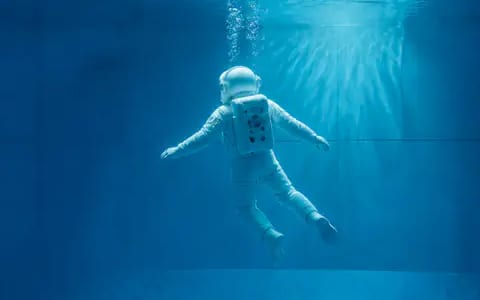
With all of these concerns and questions in mind, both the Soviet and American training programmes for astronauts and cosmonauts were very physically demanding – being spun around very quickly and submerged in water, as well as phycological tests that cosmonauts underwent such as the infamous tower of silence – where the trainee could spend up to ten days sealed in a dark and silent room where they were deprived entirely of sensory stimulation.
Once the trainees went through each test, they would then be examined by doctors and scientists to see what impact the training had on their body. One of the most famous early astronauts, Alan Shepherd first travelled to space aboard Freedom 7 in 1961. One of the original Mercury astronauts, it was expected by everyone including Shepherd himself, that when the Apollo program started, he would be guaranteed a place on one of the missions.
However, due to suffering from Ménière’s disease, an inner ear condition, it looked unlikely that Shepherd was going to get to travel into space again. If you have ever had an ear infection or have had to go to somewhere like this earwax removal Bristol based company to have blocked ear wax removed, you have likely experienced the dizziness that can come from ear problems, and of course when you add in the lack of gravity in space, this is something that nobody at NASA wanted to risk.
However, thanks to neurologist Doctor William House, Shepherd was offered an experimental operation that was a risk but could be his chance to fly to space again. Fortunately, the operation was a success, and Shepherd flew aboard Apollo 14, famously landing on the moon and even playing a bit of golf whilst there!
As missions became longer, scientists discovered that the body’s response to microgravity was more complicated than they had initially expected. Microgravity effects many parts of the body – as well as the ear and the fluids within it, it also effects the bones and the muscles.
On earth, the body is designed to live with gravity which makes the body support itself under the weight of it – when there is no gravity the muscles that are used every day on earth start to weaken as the body doesn’t have the challenge of gravity. Bones can also lose minerals as they are less active.
This is why onboard the space station there are now carefully designed exercises for astronauts to do to ensure that they keep their bones and muscles healthy when spending a long period of time in space.
Radiation is another big concern – on earth, the magnetic field and the atmosphere protect us from most harmful cosmic radiation and harmful particles but in space there is no such protection.
Radiation exposure can lead to cell and DNA damage which increases the risks of things like cancer. Spacecraft are built with radiation shielding; however, it is not possible to completely get rid of this danger.
Modern day astronauts are able to spend many months in space now thanks to the research of those early pioneers – the International Space Station helps us to learn even more about life in space as it is a science lab that can conduct these experiments in microgravity. This work helps humans to further plan to explore space further, with the Artemis missions and human flights to Mars planned for the future.