
A boutique hotel bed looks effortless, right up until you try to recreate it at home and end up with a lumpy pile of mismatched cushions. The difference is rarely the furniture. It is the layering: how many pillows, which sizes, what textures, and where the throw actually lands. Texture is what separates a flat, catalog-style bed from one that feels deliberate, and a single high-contrast piece such as faux fur pillow covers arizona can anchor an entire arrangement. Get the sequence right and the look holds together. Get it wrong and no amount of cushion volume will fix it. Here is the order to build in, plus the mistakes that flatten the effect.
Quick Answer
Layer in four stages: Euro shams standing against the headboard for height, sleeping pillows in shams leaning in front of them, square accent pillows in the middle, and one lumbar or textured pillow at the very front. Add a throw draped diagonally across the foot of the bed so it falls about a third of the way down. The rule that matters most is contrast — mix at least one rough or fluffy texture against smooth bedding, and keep the palette to two or three colors.
Key Takeaways
- Build from back to front: Euro shams, sleeping pillows, square accents, then a single front pillow. Each layer has a job.
- Texture contrast reads as “styled” more reliably than color contrast. One faux fur or chunky-knit piece is usually enough.
- An odd number of front pillows looks more relaxed than a symmetrical pair, but symmetry works better on very wide beds.
- Throw placement matters more than throw size — a diagonal drape beats a folded rectangle every time.
- If you use the bed daily, plan for a two-minute reset rather than a ten-minute restyle.
The Layering Order That Creates the Hotel Effect
Hotel beds look intentional because each layer is doing a specific job, and the layers get progressively smaller and softer as they move forward. Skipping a layer, or putting them in the wrong order, is why home attempts often look cluttered rather than composed.
| Layer | Pillow Type | Typical Size | Placement | Job |
|---|---|---|---|---|
| 1 (back) | Euro shams | 26 x 26 in | Standing upright against headboard | Height, structure, backdrop |
| 2 | Sleeping pillows in shams | Standard or queen | Leaning in front of Euros | Softness and depth |
| 3 | Square accent pillows | 18 x 18 or 16 x 16 in | Centered in front of layer 2 | Color and pattern |
| 4 (front) | Lumbar or textured pillow | 12 x 24 or 12 x 16 in | Front center | Finishing detail |
Two Euro shams are standard for a queen, three for a king. If your headboard is tall and architectural, Euro shams can compete with it — in that case, start at layer two and let the headboard be the backdrop.
How Many Pillows Is Actually Right?
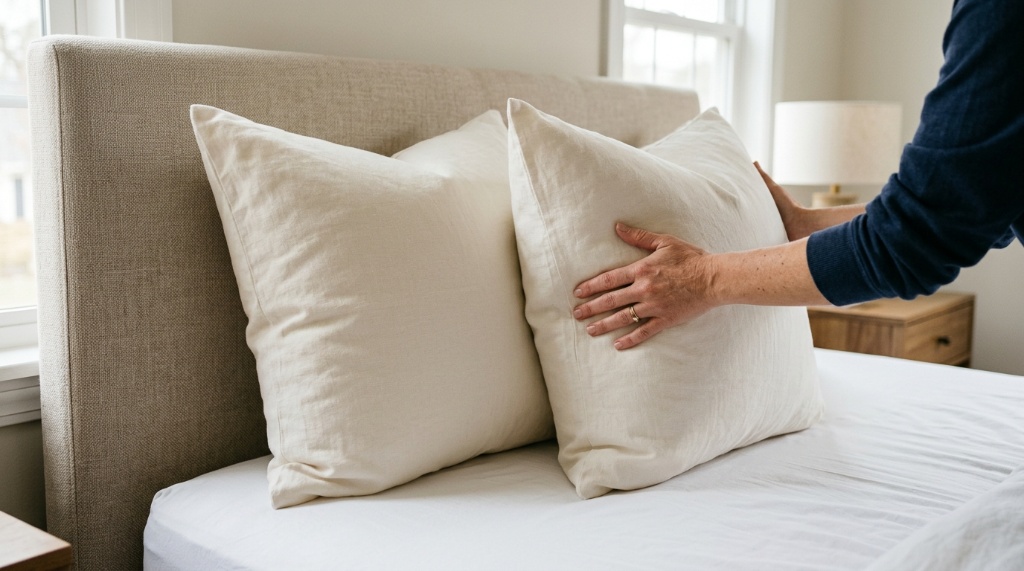
Most boutique-hotel beds use six to eight pillows total, not the twelve-pillow towers you see in showrooms. More than that and the bed stops looking calm.
A practical formula: two Euro shams, two sleeping pillows, two square accents, one front pillow. That is seven pieces on a queen or king, and it photographs and functions well. On a full or twin, drop to one Euro, two sleeping pillows, and one accent.
There is a functional argument here too. Pillows you actually sleep on should be the ones directly behind your head, which means layers three and four exist purely for looks. If removing four pillows every night sounds exhausting, keep the accent layers to two pieces and accept a slightly simpler composition. A bed you resent restyling will end up bare within a week.
Why Texture Beats Color for This Look
Color gets the attention, but texture is what makes a bed read as luxurious. Two pillows in the same color but different textures — say a smooth cotton sham and a fluffy faux fur cover — create more visual interest than two contrasting colors in identical fabrics.
This is where a faux fur piece earns its place. Faux fur reflects light differently than flat-weave bedding, which creates depth even in a monochrome room. Grey is a particularly useful choice because it sits between warm and cool tones, so it works whether your bedding is ivory, charcoal, or a muted blue.
Where to Place a Faux Fur Pillow
Put it in the front layer or as one of the square accents — not both. Two faux fur pillows in a stack of seven is plenty; three starts to look like a display rather than a bed. If your bedding is already heavily textured (linen with visible slubs, chunky knit throws), use a single faux fur accent and let it be the focal point.
Texture Pairings That Work
- Faux fur + crisp cotton or percale — maximum contrast, very hotel-like
- Faux fur + washed linen — softer contrast, more relaxed and lived-in
- Velvet + linen — rich but less fluffy, better for warmer climates
- Chunky knit + smooth sateen — adds warmth without the fuzz
Avoid pairing faux fur with another high-pile fabric like chenille or sherpa. The two textures compete and the bed starts to look heavy.
Throws: Size, Weight, and Drape
The throw is the most commonly mishandled element. A throw folded into a neat rectangle across the foot of the bed looks like a folded towel. A throw draped at an angle, with one corner falling toward the floor, looks styled.
For a queen or king, look for a throw roughly 50 x 60 inches or larger. Anything smaller will not span the width of the bed and will slide off during the night. On a king, a 60 x 80 inch throw gives you enough fabric to drape without stretching.
Weight matters more than most people expect. A heavy knit or wool throw holds its drape and stays where you put it. A thin cotton throw will slip and needs constant readjusting. If you want the look without the weight, choose a textured weave rather than a lightweight flat one, When upgrading your sleep sanctuary with luxury layers, it is also important to choose the right fill for your ergonomic needs—learn more by checking out our guide on compare buckwheat pillows in california.
A Simple Drape Method
- Lay the throw across the foot of the bed, roughly a third of the way up from the bottom edge.
- Pull one side so it hangs noticeably lower than the other — an uneven drape reads as intentional.
- Let the excess fall over the side rather than tucking it under the mattress.
- Smooth the top edge once with your hand and stop. Over-fussing flattens the texture.
Common Mistakes That Undo the Look
Most failed attempts trace back to one of a few specific errors.
- Using undersized inserts. A 16 x 16 cover with a 14 x 14 insert looks deflated. Inserts should be the same size as the cover, or one inch larger for a fuller look.
- Matching everything. Identical fabric across all seven pillows removes the depth you are trying to create.
- Ignoring the headboard. A dark, heavy headboard needs lighter pillows to avoid a blocky silhouette. A light headboard can carry darker accents.
- Centering the throw perfectly. Perfect symmetry looks retail, not residential.
- Buying pillows before the bedding. The bedding sets the palette; the pillows respond to it.
Making It Work in Real Life
A styled bed has to survive daily use, pets, and small rooms. A few adjustments keep the look practical.
If you have a pet that sleeps on the bed, keep faux fur and other high-pile covers in the front layer where they can be lifted off quickly, and choose covers with hidden zippers so they can be removed and shaken out. Faux fur generally should not go in a hot dryer — shaking it out and spot cleaning is usually safer than frequent machine washing, and a soft brush restores the pile after handling.
In a small bedroom, reduce the pillow count rather than the texture. Four well-chosen pillows with one strong texture will read better in a tight space than eight pieces crowding the headboard. Similarly, a lighter throw in a small room keeps the bed from dominating the space.
If you want the look without the nightly routine, treat the accent layers as a daytime arrangement. Stack the front two pillows on a chair or bench at night, and put them back in the morning. It takes under a minute and protects the decorative covers from wear.
Frequently Asked Questions
How many pillows should be on a queen bed for a hotel look?
Six to seven is the sweet spot: two Euro shams, two sleeping pillows, two square accents, and one front lumbar or textured pillow. More than eight usually looks cluttered rather than luxurious.
Should the throw match the pillows?
Not exactly. They should share a palette but differ in texture or shade. A grey faux fur pillow with a charcoal knit throw works better than two identical greys in the same fabric.
Can I use faux fur pillow covers year-round?
Yes, if you keep the rest of the bed light. Pair faux fur with cotton or linen rather than heavy flannel, and limit it to one or two pieces so the bed does not feel winter-only.
What size insert do I need for a faux fur pillow cover?
Use an insert the same size as the cover, or one inch larger if you want a fuller shape. Faux fur covers tend to look thin when the insert is undersized because the pile adds visual bulk without structural fill.
How do I keep a styled bed looking good every day?
Keep the arrangement simple enough to reset in under two minutes. Fewer pillows with stronger texture contrast hold up better to daily use than a complex stack that takes ten minutes to rebuild.
Conclusion
The boutique-hotel look comes down to sequence and contrast, not quantity. Build from Euro shams at the back to a single front pillow, vary texture at least once, and drape the throw at an angle instead of folding it flat. Start with what you already own, add one strong textural piece, and adjust the pillow count to fit how you actually use the bed. A composition you can reset in two minutes will still look styled a month from now.